

The science behind D4
Why a phone speaker sounds the way it does
A phone speaker is about the size of a fingernail. It moves very little air, and low notes need a lot of air, so bass is the first thing to go. What is left is pushed by tiny parts that ring at certain pitches, which is why voices can sound thin or nasal and music can sound boxed in. Then iOS adds its own protection: as you turn the volume up, loud and quiet moments are squeezed closer together so the speaker does not distort. The result is the sound you know, smaller, flatter and harsher than the recording that left the studio.
What D4 does about bass
The speaker can't play the lowest notes, but your ear is good at filling gaps. D4 takes what the speaker can play and shapes it so your brain hears the missing notes as if they were there. You get the weight of a kick drum or a bass line without asking the speaker to do the impossible. It is also built to be speaker-safe: D4 never pushes the speaker past what it can handle, so more bass never means damage. Bass+ leans into this for music that lives down low, and every other mode uses it with a lighter touch.
Voices
Speech lives in its consonants. The soft edges of a t, an s or a k are what make a sentence understandable, and they are the first thing a small speaker smears, especially at low volume. D4 brings those edges forward so words stay clear while you keep the volume down: a podcast while you cook, a video in bed, an audiobook on the kitchen table. Voice mode is built for exactly this. Night mode keeps dialogue and voices clear at low volume, without the sudden peaks that wake the house.
Loud without harsh
Turn a phone speaker up and it gets harsh long before it gets loud. The biggest moments, a drum hit, a gunshot in a film, a laugh, are the ones that distort first. D4 watches those peaks in real time and manages them gently, so you can turn the volume up and the sound stays full instead of sharp. The aim is simple: nothing sounds clipped or squashed. Quiet parts stay audible, and loud parts stay comfortable, even when the room is not.
It decides, you override
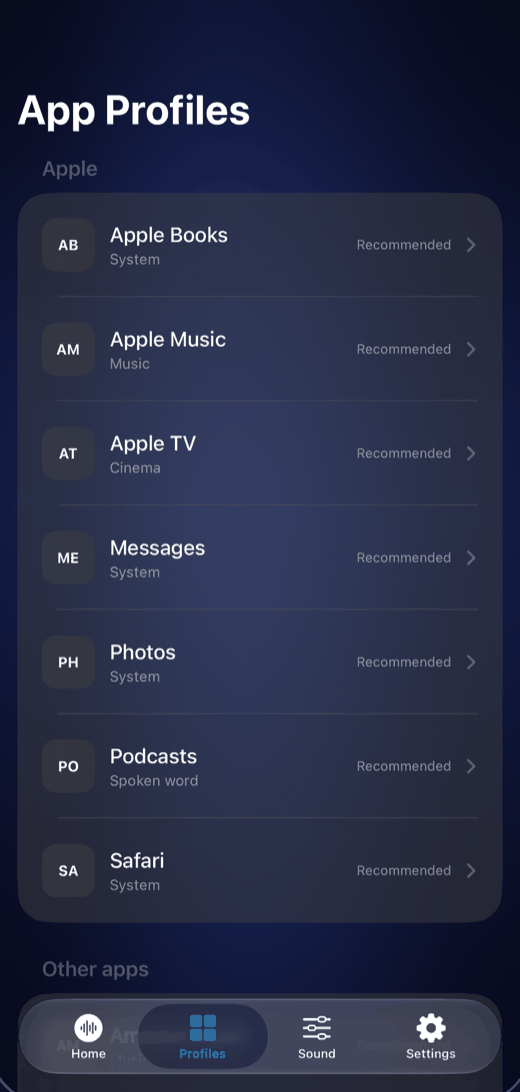
D4 listens to the shape of the sound passing through it and works out whether it's a voice, a song or a film. Then it picks the matching mode on its own, and changes when what you are playing changes. If you would rather decide, pick a mode yourself. A manual choice always wins and stays until you change it. Profiles go one step further: set a mode for an app once and D4 remembers it, so Spotify can stay on Music Boost while your podcast app stays on Voice.
Measured, not guessed
Every mode is tested on real devices at real listening levels, in rooms and on kitchen tables, not just on a graph. A setting that looks good on paper but sounds wrong in your hand does not ship. That is also why D4 is tuned for the physics of a phone speaker rather than copied from a hi-fi preset: a hi-fi curve assumes a speaker that can play the whole range, and a phone can't. We would rather give you six modes that each do their job than a long list of sliders to work out.
What we won't say
The exact tuning is the product. We publish what D4 does for you, not the recipe.